
Creation
Made with
Fat ChoyPrompt
Monochrome black-and-white zine page poster, 2:3 portrait orientation, pure white background, laser-printer optimized (no large solid black areas).
Title: "THE LUNAR CALENDAR: WHY THE DATE SHIFTS" in ultrabold display font, centered near top, with effulgent chiaroscuro fill creating depth through cross-hatching and fine linework, accompanied by a mesmerizing op-Art drop-shadow effect using concentric geometric patterns.
Below the title, create an educational page explaining the lunar calendar and its relationship to the Western calendar. The layout should include:
A central illustration depicting the relationship between lunar and solar cycles: perhaps a sophisticated diagram showing the moon's phases in orbit, calendar wheels, and the intersection of lunar months with solar seasons. Use geometric patterns, concentric circles, and fine linework to suggest both scientific precision and cosmic harmony. The illustration should feel educational and contemplative, occupying the central composition.
Below the illustration, integrate explanatory text in clean, elegant serif font:
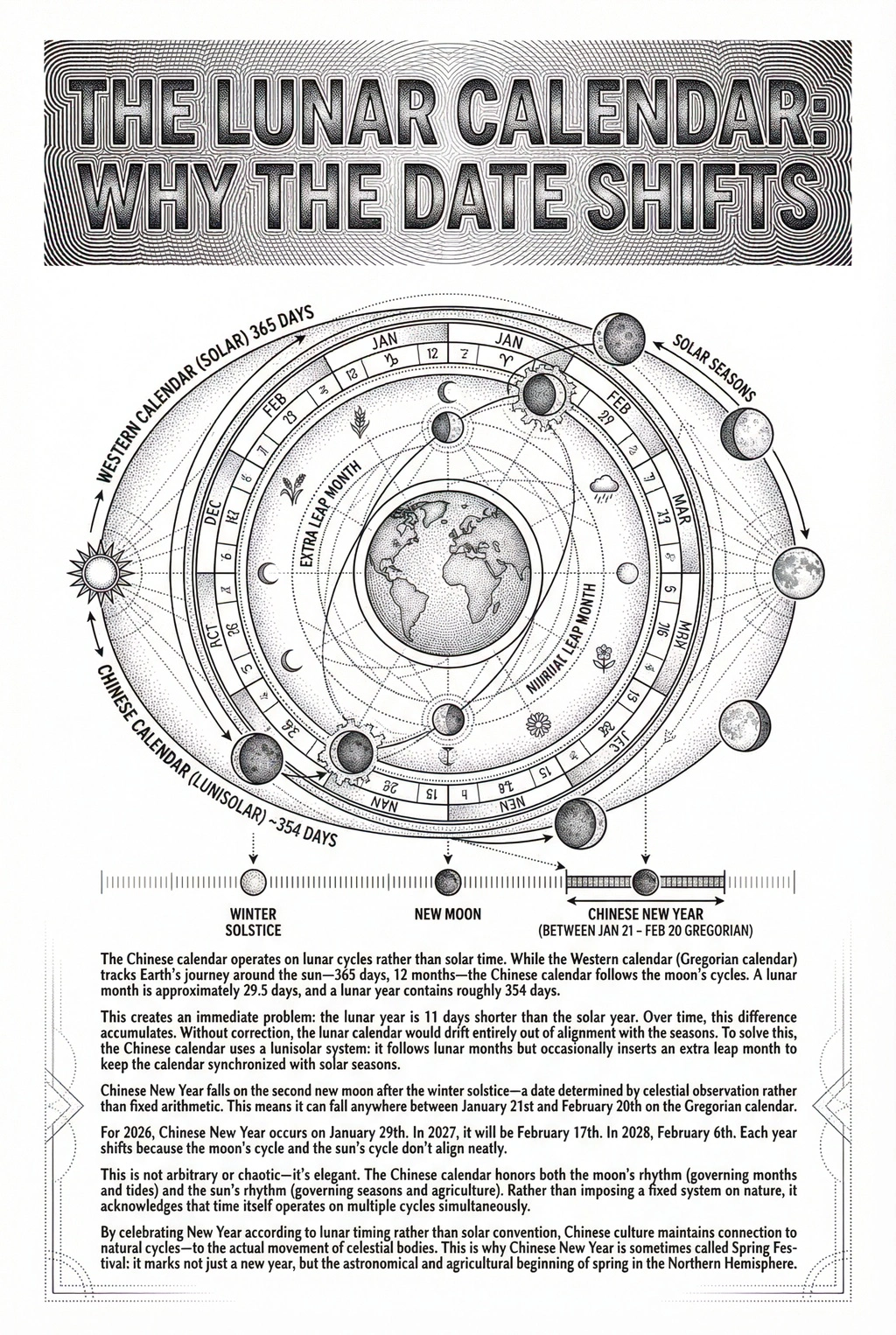
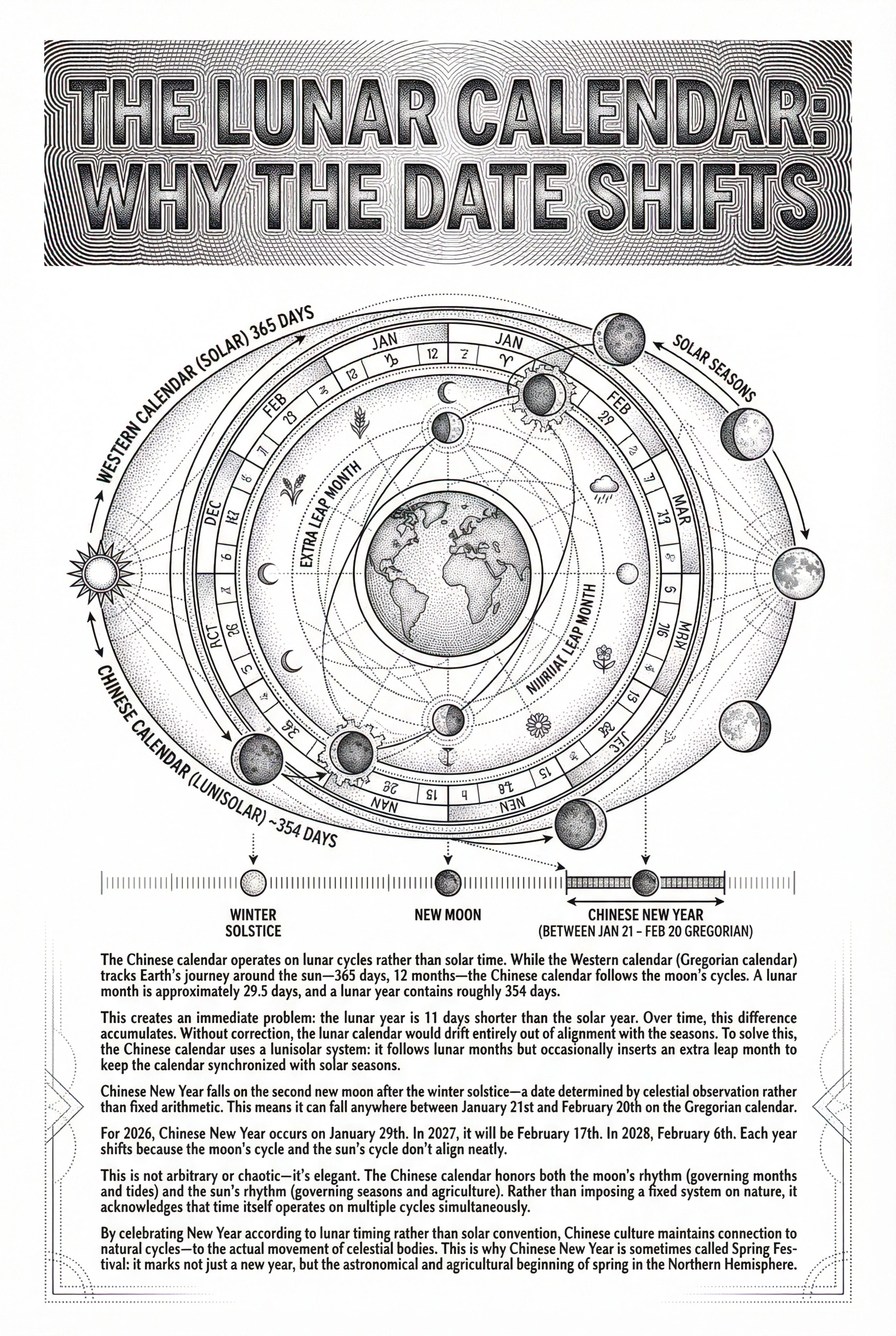
"The Chinese calendar operates on lunar cycles rather than solar time. While the Western calendar (Gregorian calendar) tracks Earth's journey around the sun—365 days, 12 months—the Chinese calendar follows the moon's cycles. A lunar month is approximately 29.5 days, and a lunar year contains roughly 354 days.
This creates an immediate problem: the lunar year is 11 days shorter than the solar year. Over time, this difference accumulates. Without correction, the lunar calendar would drift entirely out of alignment with the seasons. To solve this, the Chinese calendar uses a lunisolar system: it follows lunar months but occasionally inserts an extra leap month to keep the calendar synchronized with solar seasons.
Chinese New Year falls on the second new moon after the winter solstice—a date determined by celestial observation rather than fixed arithmetic. This means it can fall anywhere between January 21st and February 20th on the Gregorian calendar.
For 2026, Chinese New Year occurs on January 29th. In 2027, it will be February 17th. In 2028, February 6th. Each year shifts because the moon's cycle and the sun's cycle don't align neatly.
This is not arbitrary or chaotic—it's elegant. The Chinese calendar honors both the moon's rhythm (governing months and tides) and the sun's rhythm (governing seasons and agriculture). Rather than imposing a fixed system on nature, it acknowledges that time itself operates on multiple cycles simultaneously.
By celebrating New Year according to lunar timing rather than solar convention, Chinese culture maintains connection to natural cycles—to the actual movement of celestial bodies. This is why Chinese New Year is sometimes called Spring Festival: it marks not just a new year, but the astronomical and agricultural beginning of spring in the Northern Hemisphere."
The text should feel intellectually rigorous yet accessible—explaining astronomical mechanics while honoring the philosophical elegance of the system. Use fine cross-hatching and stippling throughout to maintain laser-printer optimization.
White background, crisp and clean. High contrast linework with no solid black areas.
Tool:create
Recent creations from 
marzipan